Commit fed6bb
2026-09-13 22:39:39 Nuno Oliveira: Manual git upload.| /dev/null .. PPROCESSO/General information.md | |
| @@ 0,0 1,125 @@ | |
| + | # Problema Integrado de Engenharia Química I e II - Edição 2025-26 |
| + | |
| + | ## Docentes |
| + | Nuno Oliveira (coordenador), nuno@eq.uc.pt, 914 006 725. |
| + | |
| + | Hermínio Sousa, hsousa@eq.uc.pt, 934 284 469. |
| + | |
| + | Paulo Araújo, paulo.araujo@uc.pt, 968 752 216. |
| + | |
| + | ## Horários / salas |
| + | |
| + | 1.o semestre: 6.a feira, 11h00-13h00, C18. |
| + | |
| + | 2.o semestre: 5.a feira, 09h00-11h00, C21. |
| + | |
| + | - Este horário serve sobretudo para reuniões tutoriais com cada grupo de trabalho. |
| + | - Cada grupo necessita marcar as suas reuniões, quando necessário. Para o efeito enviar uma mensagem para o coordenador, que atribuirá um horário específico. |
| + | - O calendário semanal de reuniões é divulgado antecipadamente. |
| + | - Questões simples podem ser resolvidas sem reunião (_mas apenas estas_)! |
| + | |
| + | ## Página oficial |
| + | https://wabi.eq.uc.pt/PIEQ/General%20information |
| + | |
| + | Outra informação de referência, incluindo a FUC plurianual está disponível no [InforEstudante](https://inforestudante.uc.pt/nonio/security/login.do). |
| + | |
| + | ## Lista de correio |
| + | Endereço: [pieq@eq.uc.pt](mailto:pieq@eq.uc.pt). |
| + | |
| + | Arquivo de mensagens: [Mailman](http://www.eq.uc.pt/mailman/listinfo/pieq). |
| + | |
| + | Para consultar o arquivo de mensagens é necessário usar a palavra chave atribuída inicialmente. (NOTA: também é possível recuperar esta palavra chave via _email_.) |
| + | |
| + | - A lista serve para anúncios e questões de natureza colectiva. |
| + | - No _início do semestre_ é necessário enviar o contacto de email (+ contacto telefónico) para inscrição na lista. |
| + | |
| + | ## Calendário |
| + | ### 1.o semestre |
| + | Prazos: |
| + | - Entrega da apresentação intermédia (formato PDF): 19.NOV. |
| + | - Apresentação intermédia: 21.NOV. |
| + | - Entrega relatório final (formato papel): 22.DEZ. |
| + | |
| + | Apresentação intermédia: |
| + | - Duração de 15 minutos (apresentação) + 30 minutos (discussão). |
| + | |
| + | Relatório final: |
| + | - Tamanho sugerido: 10-15 páginas (excluindo anexos). |
| + | - É necessário entregar _2 cópias impressas_. |
| + | |
| + | ### 2.o semestre |
| + | Prazos: |
| + | - Entrega relatório final (formato papel): 21.MAI. |
| + | - Apresentações: 02 e 03.JUN. |
| + | |
| + | Apresentação final: |
| + | - Duração de 15 minutos (apresentação) + 30 minutos (discussão). |
| + | |
| + | Relatório final: |
| + | - Tamanho sugerido: 10-15 páginas (excluindo anexos). |
| + | - Necessário entregar 2(3) cópias impressas. |
| + | |
| + | ## Tópicos a desenvolver |
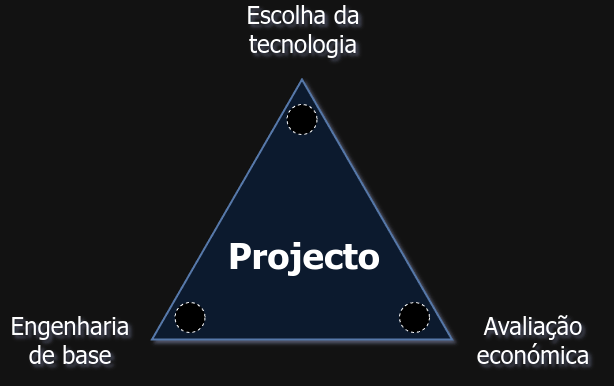
| + | De uma forma genérica, os diferentes aspectos abordados nesta unidade curricular e nas unidades curriculares consecutivas (**PIEQ-2** e **Projecto de Processo**) consistem numa perspectiva integrada de **Projecto**, podendo ser enquadrados em 3 grandes blocos de conteúdo: |
| + | - **Escolha da tecnologia a usar na aplicação.** |
| + | - **Engenharia de base e diagramas de processo.** |
| + | - **Avaliação do projecto de investimento.** |
| + | |
| + |  |
| + | |
| + | Nas unidades curriculares de **PIEQ-1** e **PIEQ-2** devem ser encetadas todas estas dimensões do problema, embora o esforço no 1.o semestre esteja sobretudo concentrado na primeiro bloco. |
| + | |
| + | Em particular, e tal como descrito nos elementos analisados nas aulas conjuntas, o relatório a elaborar no final desta unidade curricular deve abordar de forma sustentada e razoavelmente completa os aspectos de: |
| + | |
| + | 1. **Selecção da tecnologia e alternativas processuais:** |
| + | - Processos. |
| + | - Quantidades e mercados. |
| + | - Matérias-primas. |
| + | - Localização, e alguns aspectos logísticos básicos. |
| + | - Outras decisões fundamentais. |
| + | 2. **Especificação da solução processual:** |
| + | - Diagrama de blocos do processo. |
| + | - Balanços de massa preliminares (principais aspetos). |
| + | 3. **Análise do projeto de investimento associado:** |
| + | - Potencial económico da proposta. |
| + | |
| + | ## Organização de tópicos no conjunto das 3 disciplinas (PIEQ 1 e 2, e Projecto de Processo) |
| + | |
| + | Ver [documento](/PIEQ/Topic%20distribution) separado. |
| + | |
| + | ## Bibliografia |
| + | |
| + | Ver lista de [referências](/PIEQ/References) em separado, bem como outro material de Projecto de Processo. |
| + | |
| + | ## Constituição dos grupos de trabalho |
| + | - 40 inscritos (19.SET) -> 8 grupos (8*5). |
| + | - Os alunos podem formar grupos. Senão os docentes constituirão estes grupos. |
| + | - Cada grupo deve indicar *3 preferências* para a escolha do tema de trabalho, dentro da seleção proposta. A atribuição é feita por seriação de preferências. Em último caso, os empates de preferências serão decididos por sorteio. |
| + | - Os grupos **TÊM** de ter 4 ou 5 elementos. |
| + | - Cada grupo deve ter no máximo 1 inscrição provisória (ou considerada de risco). |
| + | - É necessário enviar a folha de identificação de grupos durante a próxima aulas. Incluir número do grupo, título do projecto, foto e contactos dos elementos -> ver **modelo da folha.** |
| + | |
| + | ## Temas de projecto propostos |
| + | |
| + | Ver [documento](/PIEQ/Themes%202025-26) separado. |
| + | |
| + | ## Use of Generative Artificial Intelligence (GenAI) tools: |
| + | |
| + | The use of Generative Artificial Intelligence (AI or GenAI) tools in this course is |
| + | generally allowed when limited to: |
| + | - **Translation of texts** from a foreign language. |
| + | - **Grammar revision** / review of texts written by students. |
| + | - **Citation** / indication of authors and the preparation of bibliographic lists. |
| + | |
| + | When GenAI tools are used in the course tasks, you are required to: |
| + | - At the beginning of the report, provide a statement mentioning that GenAI tools were used |
| + | for its elaboration, and list **all** of the GenAI tools used. |
| + | |
| + | Please remember that, in either case, the students are required to be aware of all of the |
| + | solution steps that were used. The students are also required to discuss the reports produced |
| + | with the instructors, to allow a clear evaluation of the student's effort and comprehension |
| + | level achieved. Any information revealed during this step might be used to adjust the student |
| + | grade, and should be considered a regular part of the grading process. |
| + | |
| + | The use of the any AI or GenAI outside the terms and scope considered here is not allowed |
| + | by default, and should be discussed in advance with the instructors. |
| /dev/null .. PPROCESSO/General information/Projecto-componentes.png | |
| /dev/null .. PPROCESSO/Groups 2026-27.md | |
| @@ 0,0 1,59 @@ | |
| + | # Working groups in the 2025-26 edition: |
| + | |
| + | ## Group 1 - Caprolactone production |
| + | - Catarina Carvalho Cardoso |
| + | - Helena Sofia Godinho Sousa (porta-voz) |
| + | - Laura Maria Ferreira Carrão |
| + | - Rita Duarte Coelho de Oliveira Gomes |
| + | - Xavier Pedrosa Marques |
| + | |
| + | ## Group 2 - 2-MethylTetraHydroFuran production |
| + | - André Rodrigues Casaleiro (porta-voz) |
| + | - Ana Eduarda Amaral Pocinho |
| + | - Marco António Henriques Portugal |
| + | - Sara Carolina Cruz de Moura (aluna de 3ª fase) |
| + | - Pedro Miguel de Almeida Lourenço Lucas |
| + | |
| + | ## Group 3 - Syngas cleaning |
| + | - Afonso B. Fernandes |
| + | - Ana Catarina F.V. Castelo (porta-voz) |
| + | - Melissa M. Soares |
| + | - Sílvia S. Santos |
| + | - Tomás F.M. Vaz |
| + | |
| + | ## Group 4 - Polyquaternium production |
| + | - Maria Carolina da Silva Parreira (porta-voz) |
| + | - Rita Isabel Silva Teixeira |
| + | - Leonor Silva Saraiva |
| + | - Maria Carolina Almeida |
| + | |
| + | ## Group 5 - Cyrene production |
| + | - Ana Rui Vigo |
| + | - Ana Santos |
| + | - Maria Augusta Seca |
| + | - Mariana Costa (porta-voz) |
| + | - Miguel Sousa |
| + | |
| + | ## Group 6 - Ethyl acrylate production |
| + | - Francisca Ferreira |
| + | - Marta Machado |
| + | - Nicole Silva |
| + | - Andresa Rodrigues |
| + | |
| + | ## Group 7 - Production of renewable methanol from urban waste |
| + | - Chelsio Pereira |
| + | - Miguel Moura (porta-voz) |
| + | - Diogo Gouveia |
| + | - Shahryar Yazdaniaski |
| + | |
| + | ## Group 8 - HexaMethyleneDiamine production |
| + | - Bruna Ramos (porta-voz) |
| + | - Mariana Fernandes |
| + | - Luis Arantes |
| + | - Tiago Cardoso |
| + | - Lara Figueiredo |
| + | |
| + | ## Group 9 - Thermochemical recycling of PE, PP plastic fractions |
| + | - Gonçalo Rodrigues |
| + | - Ozoemena Daniel |
| + | - Taliana Smith (porta-voz) |
| /dev/null .. PPROCESSO/References.md | |
| @@ 0,0 1,17 @@ | |
| + | # References |
| + | |
| + | - **G.T. Austin**, _Shreve's Chemical Process Industries_, 5.a ed., McGraw-Hill, New York, 1999. |
| + | |
| + | - **C.A. Heaton**, _The Chemical Industry_, Blackie & Son Ltd., London, 1986. |
| + | |
| + | - **D.W. Green, R.H. Perry**, _Perry's Chemical Engineers' Handbook_, 8.a ed., McGraw-Hill, New York, NY, 2008. |
| + | |
| + | - **R.M. Murphy**, _Introduction to Chemical Processes_, 2.a Ed., McGraw-Hill, New York, 2022. |
| + | |
| + | - **Seider, W.D.; Seader, J.D.; Lewin, D.R.**, _Product & Process Design Principles: Synthesis, Analysis, and Evaluation_, 4.a ed., John Wiley & Sons, New York, 2017. |
| + | |
| + | - **Turton, R.; Bailie, R.C.; Whiting, W.B.; Shaeiwitz, J.A.**, _Analysis, Synthesis, and Design of Chemical Processes_, 4.a ed., Prentice Hall International, Upper Saddle River, 2012. |
| + | |
| + | - **Wertz, J.L., Bédué, O.**, _Lignocellulosic Biorefineries_, EPFL Press, Lausanne, 2013. |
| + | |
| + | - **Wittcoff, H.A., Reuben, B.G., Plotkin, J.S.**, _Industrial Organic Chemicals_, 3.a ed., John Wiley & Sons, New York, 2013. |
| /dev/null .. PPROCESSO/Themes 2025-27.md | |
| @@ 0,0 1,121 @@ | |
| + | # Proposed themes in 2025-26 |
| + | |
| + | ## 1. Polyquaternium production (G4) |
| + | |
| + | Polyquaterniums are a group of cationic polymers used in hair and |
| + | skincare products to provide conditioning, smoothing, and |
| + | static-reducing benefits by neutralizing negative charges on hair and |
| + | skin. They can be derived from natural polymers like cellulose or |
| + | synthesized from organic monomers. The specific benefits and chemical |
| + | properties of each polyquaternium are distinguished by a unique number |
| + | (e.g., Polyquaternium-7, Polyquaternium-10), assigned in the order they |
| + | are registered with the International Nomenclature of Cosmetic |
| + | Ingredients (INCI) --- [(refs)](https://www.google.com/search?q=Polyquaterniums). |
| + | |
| + | |
| + | ## 2. HexaMethyleneDiamine production (G8) |
| + | |
| + | Hexamethylenediamine (HMD) is produced by the catalytic hydrogenation of |
| + | adiponitrile (ADN), a process where hydrogen gas is added to |
| + | adiponitrile molecules in the presence of a catalyst like Raney nickel |
| + | or cobalt, often in a solvent like molten adiponitrile or ammonia. |
| + | Adiponitrile itself is typically made from butadiene through a process |
| + | involving hydrogen cyanide. Emerging bio-based routes, like those via |
| + | fermentation of amino acids or other precursors, are also under |
| + | development to provide more sustainable alternatives --- |
| + | [(refs)](https://www.google.com/search?&q=Hexamethylenediamine+production). |
| + | |
| + | |
| + | ## 3. Ethyl acrylate production (G6) |
| + | |
| + | Ethyl acrylate is produced through the acid-catalyzed esterification of |
| + | acrylic acid with ethanol. This process typically occurs in the liquid |
| + | phase and utilizes an acid catalyst like sulfuric acid or a solid acid. |
| + | After the reaction, the crude product undergoes distillation to separate |
| + | and purify the ethyl acrylate, which is then stabilized with |
| + | a polymerization inhibitor like hydroquinone. References: |
| + | |
| + | - [BASF’s Rheovis range transitions to bio-based Ethyl Acrylate (EA)](https://www.greencarcongress.com/2025/06/20250611-basf.html). |
| + | - [Reactive distillation configuration for the production of ethyl acrylate](https://www.sciencedirect.com/science/article/abs/pii/S0255270124002022). |
| + | |
| + | |
| + | ## 4. Cyrene production (G5) |
| + | |
| + | Dihydrolevoglucosenone (cyrene) is a bicyclic, chiral, seven-membered |
| + | heterocyclic cycloalkanone which is a waste derived and fully |
| + | biodegradable aprotic dipolar solvent. It is an environmentally friendly |
| + | alternative to dimethylformamide (DMF) and N-methyl-2-pyrrolidone (NMP) |
| + | --- [(refs)](https://en.wikipedia.org/wiki/Dihydrolevoglucosenone). |
| + | |
| + | |
| + | ## 5. Thermochemical recycling of PE, PP plastic fractions (G9) |
| + | |
| + | Thermochemical recycling breaks down polyethylene (PE) into basic |
| + | chemical building blocks using high temperatures. Key processes include |
| + | pyrolysis, which converts PE into oil, char, and gas, and gasification |
| + | or steam cracking, which can also produce syngas or fuels. These methods |
| + | offer an alternative to mechanical recycling for challenging PE waste, |
| + | yielding valuable raw materials like hydrocarbons and chemicals for |
| + | reintroduction into the production cycle. References: |
| + | |
| + | - [Thermochemical recycling](https://www.google.com/search?q=Thermochemical+recycling+of+polyethylene+plastic+fractions). |
| + | - [Polyolefin waste to light olefins](https://www.science.org/doi/10.1126/science.adq7316) |
| + | - [ENEOS Mistubishi plant](https://chemanager-online.com/en/news/mitsubishi-chemical-group-launches-chemical-recycling-plant-for-plastic-to-oil-conversion). |
| + | |
| + | [](/PIEQ/Themes%202024-25/Plasticos-h3t96ur42spd1.jpg "Plásticos nos oceanos.") |
| + | |
| + | |
| + | ## 6. 2-MethylTetraHydroFuran production (G2) |
| + | |
| + | 2-methyltetrahydrofuran (2-MeTHF) has been promoted as an |
| + | ecologically-friendly alternative to THF. 2-MeTHF is produced from |
| + | renewable biomass via two primary catalytic hydrogenation pathways: from |
| + | furfural, which is first hydrogenated to 2-methylfuran (2-MF) and then |
| + | to 2-MeTHF, and from levulinic acid (LA), where LA is converted to |
| + | γ-valerolactone (GVL), then 1,4-pentanediol, which is finally dehydrated |
| + | to 2-MeTHF. The raw materials are lignocellulosic biomass, such as |
| + | corncobs or bagasse, with hydrogenation catalysts including Nickel, |
| + | Palladium, Copper, or Ruthenium on supports like alumina or carbon --- |
| + | [(refs)](https://www.google.com/search?q=2-Methyltetrahydrofuran+production). |
| + | |
| + | |
| + | ## 7. Syngas cleaning (G3) |
| + | |
| + | Syngas cleaning removes contaminants like dust, sulfur, ammonia, and |
| + | heavy metals to meet product quality, downstream process requirements, |
| + | and environmental regulations. Cleaning methods are categorized as cold |
| + | gas (low temperature, often using water scrubbing) or hot gas (high |
| + | temperature, using filters, sorbents, or catalysts). Key technologies |
| + | include cyclones, filters, wet scrubbers, solid adsorbents, catalytic |
| + | converters, and acid gas removal (AGR) systems, with choices depending |
| + | on the application and required purity --- |
| + | [(refs)](https://www.google.com/search?q=syngas+cleaning). |
| + | |
| + | |
| + | ## 8. Production of renewable methanol from urban waste (G7) |
| + | |
| + | Renewable methanol is produced from urban waste by first processing the |
| + | waste into a synthesis gas (syngas) through methods like gasification or |
| + | partial oxidation, which is then purified and converted into methanol. |
| + | This process offers a way to recycle non-recyclable waste and create |
| + | a versatile fuel for transportation and chemicals, contributing to |
| + | carbon neutrality and the circular economy. References: |
| + | |
| + | - [Renewable methanol from urban |
| + | waste](https://www.google.com/search?q=Production+of+renewable+methanol+from+urban+waste). |
| + | - [New Repsol / Enerkem Ecoplanta in |
| + | Tarragone](https://www.repsol.com/en/sustainability/sustainability-pillars/environment/circular-economy/our-projects/transforming-waste-into-chemicals/index.cshtml). |
| + | |
| + | |
| + | ## 9. Caprolactone production (G1) |
| + | |
| + | Caprolactone (ε-CL) is a monomer used in the production of highly |
| + | specialised polymers. Ring-opening polymerization, for example, gives |
| + | polycaprolactone. Another polymer is polyglecaprone, used as suture |
| + | material in surgery. ε-caprolactone is produced industrially through |
| + | several methods, primarily via the Baeyer-Villiger oxidation of |
| + | cyclohexanone using peracetic acid or catalytic systems with oxygen. |
| + | Alternative methods include the biocatalytic conversion of cyclohexanol |
| + | using enzymes like Baeyer-Villiger monooxygenases and the direct |
| + | condensation of 6-hydroxyhexanoic acid --- |
| + | [(refs)](https://www.google.com/search?q=%CE%B5-caprolactone+sources). |
| /dev/null .. PPROCESSO/Topic distribution.md | |
| @@ 0,0 1,91 @@ | |
| + | # Topic distribution |
| + | |
| + | ==**PIEQ-1** >> **PIEQ-2** >>> **Projeto de Processo**== |
| + | |
| + | ## PIEQ-1 |
| + | |
| + | > [!IMPORTANT] |
| + | > Ponto de partida: **especificação do problema**. |
| + | |
| + | Validação da especificação inicial do problema e definição de objetivos específicos. |
| + | |
| + | **Estudo de mercado**, **seleção de tecnologia**, e especificação do processo: |
| + | – Vias de produção possíveis + escolha da tecnologia a usar (patentes, estudos científicos, etc.). |
| + | |
| + | Análise crítica das tecnologias disponíveis (identificar aspetos chave, core do processo) ... |
| + | |
| + | Estrutura funcional do processo – diagrama de blocos. |
| + | |
| + | Potencial económico preliminar: Receitas – Despesas > > zero !!! |
| + | |
| + | por exemplo, vendas de produto(s) – custos de matéria-prima – outros custos antecipáveis >> zero !!! |
| + | |
| + | R1 - Relatório (10 - 15 páginas). |
| + | > [!TIP] |
| + | > Seguir a estrutura (simplificada) do relatório final de Projeto de Processo! |
| + | |
| + | ## PIEQ-2 |
| + | |
| + | > [!IMPORTANT] |
| + | > Ponto de partida: (corrigir) finalizar **R1**! |
| + | |
| + | - Diagrama de blocos do processo detalhado (completo!): validar a estrutura do processo com a equipa de docentes). |
| + | - Descrição detalhada do processo. |
| + | - Construção do **PFD – Process Flow Diagram**. |
| + | - Balanços de massa preliminares (abordagem linear) e estrutura de reciclo do processo. |
| + | |
| + | R2 – relatório (20 - 30 páginas) (… extensão de R1) |
| + | > [!TIP] |
| + | > Seguir a estrutura do relatório final de Projeto de Processo! |
| + | |
| + | ## Projecto de Processo |
| + | |
| + | > [!IMPORTANT] |
| + | > Ponto de partida: corrigir e completar **R2 **! |
| + | |
| + | - PFD & balanços de massa + balanços de energia. |
| + | - Projecto das unidades principais do diagrama e otimização das condições de funcionamento. |
| + | - Integração energética. |
| + | - Circularidade: tratamento de efluentes e racionalização de consumos de água. |
| + | - Balanços de massa (e energia) finais. |
| + | - _P&I – Pipping & Instrumentation diagrams_ – **Diagramas de instrumentação & controlo** |
| + | - Principais aspectos de segurança (HAZOP). |
| + | - Layout. |
| + | - Análise detalhada do projeto de investimento (+ indicadores económicos). |
| + | - Conclusões e recomendações do estudo. |
| + | |
| + | R3 – relatório final (< 70 páginas) (… extensão de R2). |
| + | > [!TIP] |
| + | > Seguir a estrutura do relatório final de Projeto de Processo! |
| + | |
| + | ### ==Estrutura sugerida para o relatório final:== |
| + | |
| + | **Resumo executivo** |
| + | |
| + | 1. **Introdução** |
| + | 1. Caracterização do problema: |
| + | * Objetivos. |
| + | * Pontos de partida; estado da arte. |
| + | * Âmbito do projeto: o que se vai fazer? |
| + | 2. Estudo de mercado: |
| + | * Diretivas: mercados, volumes, etc. |
| + | * Estratégia a usar. |
| + | 2. **Caracterização do processo:** |
| + | 1. Descrição da tecnologia usada. |
| + | 2. Estrutura do processo: |
| + | * Diagramas de blocos. |
| + | * PFD. |
| + | 3. Balanços de massa / energia. |
| + | 3. **Especificação do equipamento (dimensionamento)** |
| + | 4. **Aspetos complementares** |
| + | 1. Tratamento de resíduos. |
| + | 2. Sistemas de utilidades e instalações auxiliares. |
| + | 3. Controlo e automação (diagramas de instrumentação e controlo – P&ID). |
| + | 4. _Layout_. |
| + | 5. Segurança. |
| + | 5. **Análise do projeto de investimento** |
| + | 6. **Conclusões e recomendações** |
| + | |
| + | **Anexos** |
| + | * Folhas de especificação dos equipamentos. |
| + | * etc. |